Sarah's false statement and retraction
Down Cemetery RoadSarah Trafford’s false statement and retraction mark a shift from being managed by other people to challenging the official account herself. Advised by Simon Smith to accept responsibility for cocaine and implicate Joe Silvermann, she signs a statement that presents her as a purchaser and user. Later, she tells Inspector Ruskin that the account was untrue and made under duress, setting a new statement against the police’s threat of consequences for retracting it.
Advice Under Pressure
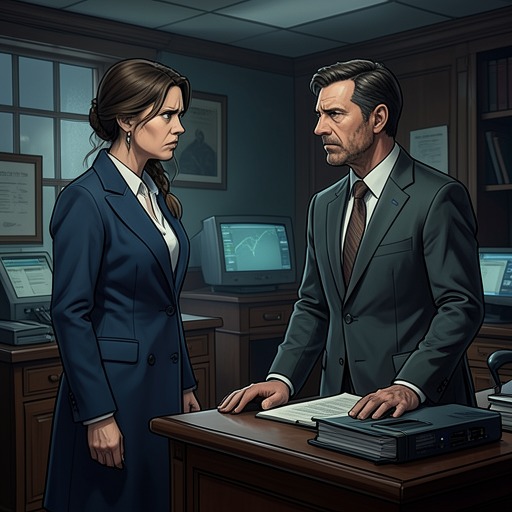
When Simon Smith asks what happened, Sarah responds that she did nothing wrong. His reassurance does not amount to confidence in her innocence: she recognizes that he is Mark Trafford’s old friend, and that their friendship is shaping the conversation. Simon is not principally concerned with whether she is guilty. His attention sharpens briefly at the possibility that Mark planted the cocaine, but Sarah does not accuse her husband.
Simon instead advises her to say the cocaine was hers and to name Joe Silvermann as its source. The statement he proposes is specific: she should say she bought drugs from Joe twice and met him in a pub. He also recommends presenting herself as depressed and out of work, and seeking therapy. These are elements of a strategy Simon constructs for the police, not facts independently established about Sarah’s history or her dealings with Joe.
His calculation is shaped by the death of Lizbeth Moss. Less than a week after a child has died taking a happy pill, he argues, the police are not likely to welcome a legal challenge to their search or to recreational drug use. In his view, they want a person they can display to the press as responsible for Lizbeth’s death. He treats a false admission as a way to steer Sarah through the immediate danger, while Sarah’s initial insistence that she has done nothing wrong goes unanswered as a question of truth.
The Statement and Its Cost
Simon’s advice becomes an official account when Sarah signs a statement saying the cocaine in her possession came from Joe. It also attributes two purchases and a pub meeting to her. Simon assures her that cooperating will effectively end official interest in her. The immediate consequence is a reduction in police contact, but the account places responsibility on Joe and makes Sarah’s own words part of the case against him.
The episode unfolds while Sarah is taking medication that dulls her fear and shaking. Blue pills at night and red pills on waking help her get by; with time, their function as reminders of the world beyond them becomes more important than their initial effect. She is uncertain whether the world’s growing fuzziness comes from shock or tranquillized stupor, and notices that the pills make it easier to believe what they help her believe. That compromised calm forms the setting for her compliance, without proving that medication alone caused her to sign.
Simon’s manner also stays with her in fragments. She fails to thank him, while Mark does so with exasperated patience; later, small pieces of memory return at inappropriate moments, sometimes concerning Joe. The statement is therefore not simply a settled transaction whose personal consequences disappear when police contact lessens. Its account of Joe remains lodged in Sarah’s recollections, even when remembering him is usually painless.
Retraction and Confrontation
When Sarah later decides to act, she is told to call Wigwam or someone else for company. The suggestion irritates her because it assumes Wigwam will be available, though Sarah suspects the assumption may be right. After ending the call, she contacts the police. The narration notes that a long silence will follow between her and the person she has just spoken with, but Sarah does not know that as she makes the next call.
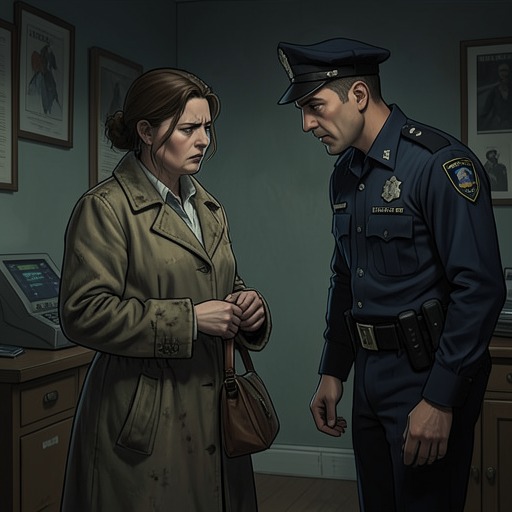
Inspector Ruskin is available. Sarah tells him that her previous statement was not true. His response is hostile: he challenges the basis for her retraction, asks whether she has taken legal advice, and warns her that wasting police time and making false statements are offences. The exchange turns the earlier statement back on Sarah. What Simon presented as a practical route out of official interest is now something the police can use to question her credibility and threaten consequences.
Sarah answers by asserting that she made the statement under duress. She says she will attend the station the next day to make a fresh one; failing that, she will call a press conference. Her threat does not establish that the police accept her account, nor does the episode confirm that she subsequently gives the fresh statement. It does establish that she is no longer allowing Simon’s proposed version to stand without challenge.
Significance and Unresolved Outcome
The reversal is carried out through speech: first Sarah’s signature lends force to a false account, then her words to Ruskin contest it and announce a public alternative. Neither speech immediately guarantees its intended result. Simon’s promise that cooperation will end police interest proves no protection against the later danger of retracting; Sarah’s threat to go to the press, meanwhile, remains a threatened action rather than a reported outcome.
The conflict also exposes how competing pressures narrow Sarah’s choices. Simon frames the false statement as a response to a police investigation shaped by the public anger surrounding Lizbeth Moss’s death. Ruskin frames retraction as a possible offence. Between those positions, Sarah first accepts an account that implicates Joe and then insists that her own earlier words were obtained under duress. The episode ends not with resolution, but with her trembling and wondering what she has done and what consequences will follow.